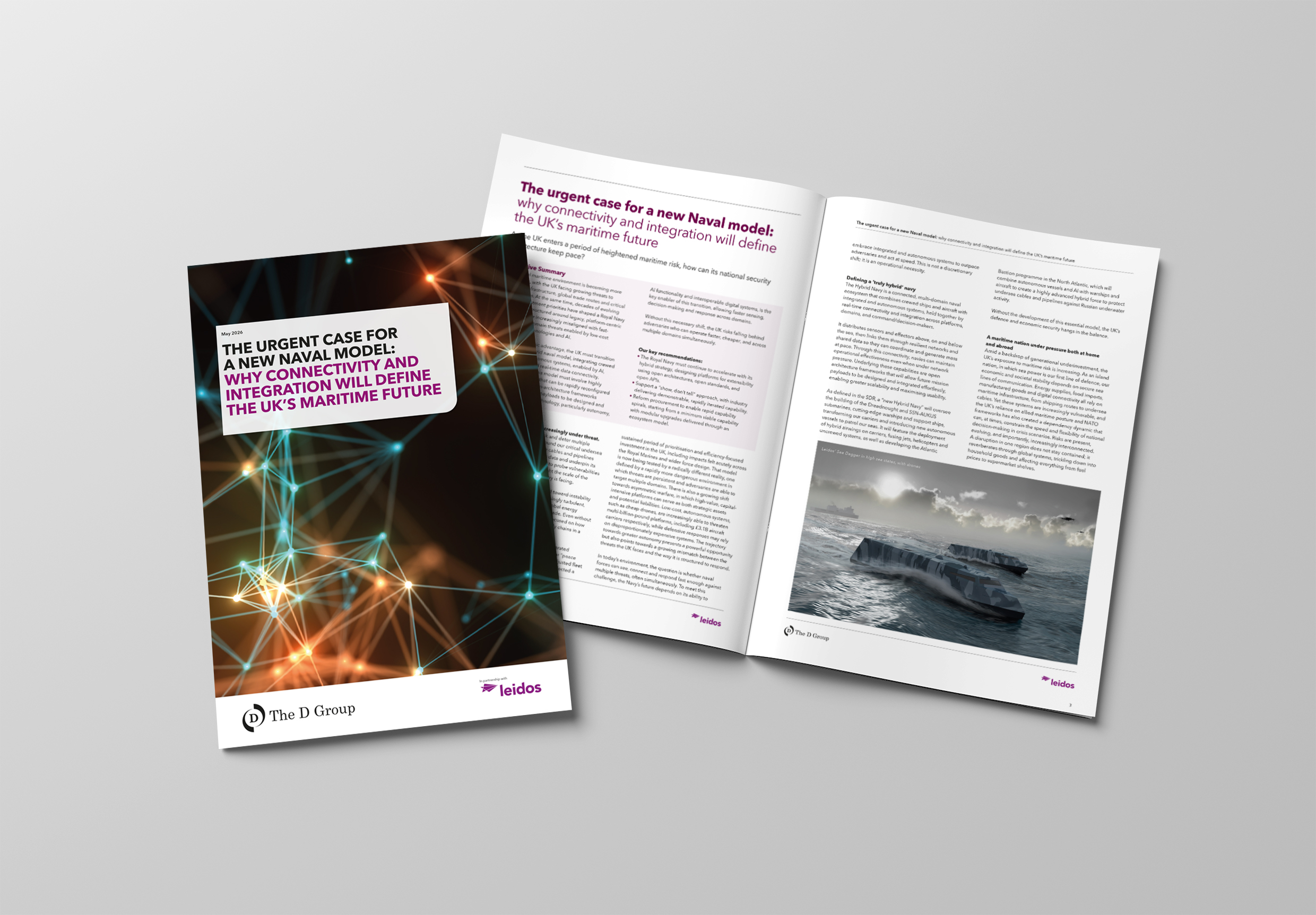
The global maritime environment is becoming more dangerous, with the UK facing growing threats to undersea infrastructure, global trade routes and critical supply chains. At the same time, decades of evolving defence investment priorities have shaped a Royal Navy that remains structured around legacy, platform-centric systems that are increasingly misaligned with fast-moving, multi-domain threats enabled by low-cost autonomous technologies and AI.
Our recent event, held in partnership with Leidos and featuring Major General Paul Maynard OBE, Director Strategy and Policy, Assistant Chief of the Naval Staff, explored the challenges of moving from the “peace dividend” to warfighting readiness, as well as developing capability at speed. What became clear through the conversation is that without a necessary shift towards a connected, hybrid naval model that integrates crewed platforms with autonomous systems, enabled by AI, open architecture and real-time data connectivity, the UK risks falling behind adversaries who can operate faster, cheaper, and across multiple domains simultaneously.
In this paper, we reflect on the significance of treating connectivity as a core element of combat power and set out what will be required to develop a truly Hybrid Navy capable of operating, adapting and prevailing in an increasingly contested maritime environment.